



Quick Answer
For most Pakistani skin types, a broad-spectrum SPF 50 sunscreen is the right starting point. Look for the label “PA+++” or “PA++++” alongside SPF, as this confirms UVA protection, which is the main driver of pigmentation and premature ageing in our climate. Match the formula to your skin type: gel or matte finish for oily skin, a lotion or cream base for dry skin, and a mineral (zinc oxide) formula for sensitive or pigmentation-prone skin. Apply it every single morning, including on cloudy days and indoors.
Sunscreen is one of those products that most people in Pakistan own but very few use correctly. It sits on the bathroom shelf for summer trips to the beach, comes out during Eid photos, and gets forgotten the rest of the year. That habit costs skin health over time.
Pakistan sits between latitudes 24°N and 37°N, which means the country receives intense solar radiation for most of the year. According to the World Health Organization, a UV index of 8 or above is classified as “very high” and requires active sun protection. Cities like Karachi, Multan, and Lahore regularly hit UV index 10 to 11 during summer, which is in the “extreme” category. Even Islamabad, with its cooler winters, crosses UV index 8 from March through October.
The good news is that choosing the right sunscreen doesn’t require a dermatology degree. Once you understand four simple factors — SPF number, PA rating, filter type, and formula texture — picking the right product for your skin becomes straightforward. Sun damage in Pakistan shows up as pigmentation, melasma, and uneven tone far more often than it shows up as visible burning, which is why so many people underestimate how much protection they actually need.
پاکستانی جلد کے لیے سن اسکرین | Sunscreen for Pakistani Skin
پاکستان میں سورج کی شعاعیں سال کے بیشتر حصے میں انتہائی تیز ہوتی ہیں، اس لیے روزانہ سن اسکرین لگانا ضروری ہے۔ SPF 50 اور PA+++ والی براڈ اسپیکٹرم سن اسکرین پاکستانی جلد کے لیے موزوں ترین ہے۔ تیلی جلد کے لیے جیل یا میٹ فارمولا، خشک جلد کے لیے موئسچرائزنگ کریم، اور حساس جلد کے لیے منرل سن اسکرین بہتر ہوتی ہے۔ سن اسکرین کو باہر جانے سے 20 منٹ پہلے لگائیں اور ہر دو گھنٹے بعد دوبارہ لگائیں تاکہ جلد کو مکمل تحفظ ملے۔
What SPF Number Do You Actually Need in Pakistan?
SPF, or Sun Protection Factor, measures how much a sunscreen extends the time your skin can tolerate UVB rays before burning. SPF 30 blocks roughly 97% of UVB rays, while SPF 50 blocks approximately 98%. That 1% difference sounds small but matters significantly under Pakistan’s extreme UV conditions, where even 15 to 20 minutes of unprotected exposure can cause measurable skin damage in South Asian skin tones (Fitzpatrick types III to V, which describes most Pakistani complexions).
For daily city use in Karachi, Lahore, or Islamabad, SPF 50 is the practical minimum. People who work outdoors, commute by rickshaw or motorbike, or spend time on construction sites or farms should consider SPF 60 or higher. Those who mostly stay indoors with limited window exposure can manage with SPF 30, though SPF 50 remains the safer default.
One number most Pakistani buyers overlook is the PA rating, printed as PA+, PA++, PA+++, or PA++++. This rating measures UVA protection, the rays that penetrate deeper into skin and cause pigmentation, melasma, and premature ageing. A sunscreen that only shows an SPF number without a PA rating offers incomplete protection. For Pakistani skin, which is highly prone to post-inflammatory hyperpigmentation, look for PA+++ at minimum, and PA++++ if you are managing melasma or dark spots.

| SPF Level | UVB Blocked | Best For | Approx. PKR Price Range |
|---|---|---|---|
| SPF 30 | ~97% | Mostly indoors, low sun exposure | Rs. 500 to 1,200 |
| SPF 50 | ~98% | Daily city use, commuting | Rs. 1,000 to 3,500 |
| SPF 60+ | ~98.3% and above | Outdoor workers, melasma, prolonged sun | Rs. 2,000 to 5,500 |
Mineral vs Chemical Sunscreen: Which One Suits Pakistani Skin?
There are two main types of sunscreen filters: mineral (also called physical) and chemical. Each works differently, and each has a specific use case for Pakistani skin.
Mineral sunscreens contain zinc oxide or titanium dioxide. These ingredients sit on the skin’s surface and physically reflect UV rays away. They’re the better choice for sensitive skin, pigmentation-prone skin, and anyone dealing with melasma, because they don’t generate heat on application. The downside is the white cast they leave on medium to deep brown skin, which is the dominant complexion range in Pakistan. Micronised or nano-particle mineral formulas reduce this significantly, so check the label for “micronised zinc oxide” if white cast is a concern.
Chemical sunscreens use active ingredients such as avobenzone, octinoxate, or newer-generation filters like Tinosorb S and Tinosorb M. These absorb into the skin and convert UV rays into heat. They blend invisibly, making them far more practical for everyday wear on Pakistani skin tones. The trade-off is that some older chemical filters (particularly oxybenzone) can irritate reactive skin. Newer hybrid formulas that combine a small amount of mineral zinc oxide with modern chemical filters offer the best of both worlds: invisible finish with strong broad-spectrum cover.
A practical rule: if your skin is sensitive or you’re managing melasma, lean mineral or hybrid. If your skin tolerates most products and you want something light and invisible under makeup, a modern chemical or hybrid formula works well.
Sunscreen by Skin Type: Matching the Formula to Your Face
The formula matters as much as the SPF number. A sunscreen you find comfortable is one you’ll actually use daily, and daily use is what delivers results.
Oily and Acne-Prone Skin
Oily skin is the most common skin type among younger Pakistanis, particularly in humid cities like Karachi during the monsoon months. Heavy cream sunscreens can feel suffocating, clog pores, and worsen breakouts. Look for gel-based or fluid sunscreens labelled “non-comedogenic” (meaning they don’t block pores) and “matte finish.” Ingredients like niacinamide (a form of vitamin B3 that controls oil production) and zinc oxide are helpful additions. Avoid sunscreens with heavy silicones or occlusive oils as primary ingredients.
Dry Skin
Dry skin, more common in Islamabad and Peshawar during winter months, needs a sunscreen that also provides hydration. Look for formulas containing hyaluronic acid (a molecule that retains moisture in skin), glycerin, or ceramides (lipids that reinforce the skin barrier). A lotion or cream texture works better than a gel, which can feel tight on dry skin. Avoid alcohol-heavy formulas, which strip moisture further.
Sensitive Skin and Pigmentation-Prone Skin
Pakistani skin is genetically more prone to post-inflammatory hyperpigmentation, meaning any inflammation, whether from acne, a rash, or sun damage, tends to leave a dark mark that lingers for months. For this skin type, mineral sunscreens with zinc oxide are the safest choice because they don’t trigger additional heat or irritation. Fragrance-free formulas reduce the risk of contact dermatitis. If you’re already using a retinol or vitamin C serum for pigmentation, sunscreen isn’t optional, it’s what makes those treatments actually work.
Combination Skin
Combination skin, oily in the T-zone (forehead, nose, chin) and normal to dry on the cheeks, is well-suited to a lightweight lotion or semi-matte formula. A single product applied evenly across the face usually works fine. Avoid very heavy creams on the T-zone and very drying gels on the cheeks.
If you’re dealing with persistent melasma, severe pigmentation, or skin reactions to sunscreen ingredients, a dermatologist can identify the exact cause and recommend a targeted treatment plan alongside sun protection.
How to Apply Sunscreen Correctly: 6 Steps Pakistani Skin Needs
- Apply 20 minutes before going outside. Chemical sunscreens need time to bind to the skin and become active. Applying them at the door and stepping straight into the Lahore afternoon sun means the first 15 to 20 minutes are under-protected.
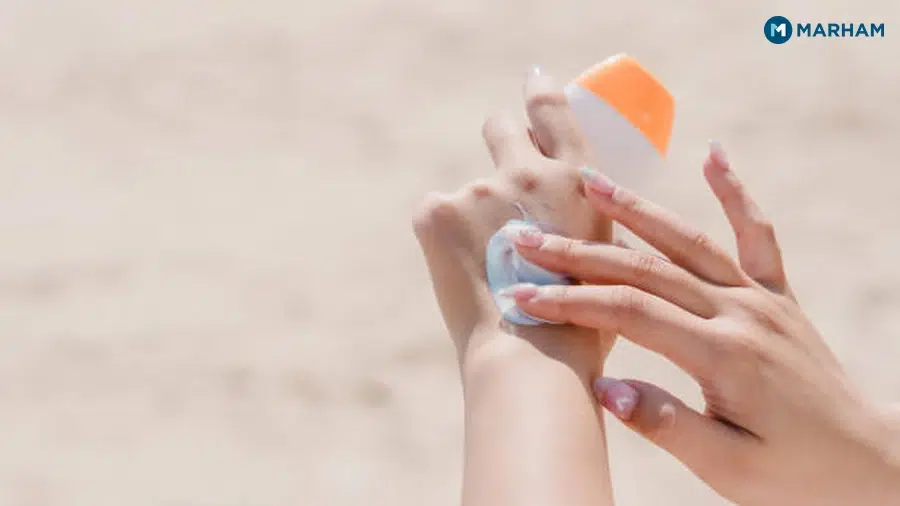
- Use the two-finger rule for your face and neck. Squeeze sunscreen along the length of your index and middle fingers, held together. That amount covers your face and neck adequately. Most people apply 25 to 50% of the recommended quantity, which significantly reduces effective protection.
- Don’t mix sunscreen with your moisturiser. Many people in Pakistan mix their sunscreen into their day cream to save time. This dilutes the SPF and disrupts the even film the formula needs to form on skin. Apply moisturiser first, let it absorb for a minute, then apply sunscreen as a separate layer on top.
- Reapply every 2 hours when outdoors. Sweat, humidity, and physical touch break down the protective film. In Karachi’s June heat or during Lahore’s dust-heavy afternoons, reapplication matters more than the SPF number on the bottle. A compact powder SPF or a sunscreen spray makes midday reapplication practical without disturbing makeup.
- Apply on cloudy days too. Up to 80% of UV rays penetrate cloud cover, according to the American Academy of Dermatology. Overcast Islamabad winters still deliver meaningful UV exposure, especially at altitude.
- Don’t forget the ears, back of the neck, and hands. These areas receive constant sun exposure during commutes and outdoor work, and they’re where pigmentation and premature ageing appear earliest. Hands in particular are often neglected; a small amount of face sunscreen applied to the backs of the hands during morning routine adds meaningful protection over years.
Common Sunscreen Mistakes That Reduce Protection
Most sunscreen failures in Pakistan come down to application errors rather than product quality. Applying too little is the most common: the SPF rating on a bottle is calculated at a specific application thickness, and using half that amount can drop effective protection from SPF 50 to something closer to SPF 15 to 20.
Skipping sunscreen on indoor days is another frequent mistake. UVA rays, the ones responsible for pigmentation and ageing, pass through glass windows. If you sit near a window at work or study at home with daylight coming in, you’re receiving meaningful UVA exposure without realising it. This is particularly relevant for people managing melasma, where even low-level daily UVA exposure can sustain the condition despite topical treatments.
A third mistake is treating sunscreen as a summer-only product. Dermatologists at Aga Khan University Hospital and other major centres in Pakistan consistently note that patients with melasma and uneven pigmentation often report using sunscreen only from May to August. UVB rays peak in summer, but UVA remains present year-round. Winter sun in Quetta or Murree can still cause cumulative skin damage over years of unprotected exposure. For more on keeping skin healthy through the warmer months, the guide on summer skin problems in Pakistan covers related conditions worth knowing about.
When to See a Dermatologist About Your Skin and Sun Protection
Sunscreen prevents damage, but it doesn’t treat existing skin conditions. If you’re already dealing with significant melasma, persistent dark patches, or a history of unusual moles or skin lesions, a dermatologist in Pakistan can assess whether your sun protection routine is sufficient or whether additional treatment is needed. Conditions like melasma often require prescription-grade treatments alongside daily SPF use, and self-managing with over-the-counter products alone can mean months of slow progress when a targeted plan would work faster.
People with very fair skin (less common in Pakistan but present in northern regions like Gilgit-Baltistan and parts of KPK), a personal or family history of skin cancer, or a job that involves daily outdoor exposure for several hours should discuss their specific sun protection needs with a specialist rather than relying on general guidelines.
Managing melasma, dark spots, or sun damage is easier with the right specialist guidance. Marham connects you with verified
Frequently Asked Questions
Is sunscreen necessary for wheatish or darker Pakistani skin tones?
Yes, all skin tones need daily sun protection. Darker and wheatish skin tones are less prone to sunburn but are significantly more prone to hyperpigmentation and melasma from UV exposure. Melanin provides some natural UV defence, but not enough to prevent long-term damage in Pakistan’s high UV index environment.
Do I need sunscreen if I stay indoors?
Yes, if you sit near windows. UVA rays penetrate glass and cause pigmentation and premature ageing even without direct sunlight. If your workspace or home has significant window exposure, daily SPF is still relevant.
Can oily skin use sunscreen every day without breaking out?
Yes, with the right formula. Gel-based, non-comedogenic sunscreens labelled “oil-free” and “matte finish” are specifically designed for oily and acne-prone skin. Avoid cream or lotion formulas with heavy emollients, which can clog pores and worsen breakouts.
Does sunscreen block vitamin D production?
Sunscreen reduces but does not completely block vitamin D synthesis. Brief, incidental sun exposure on the arms or legs (10 to 20 minutes on most days) is generally sufficient for vitamin D production in Pakistan’s sunny climate, even with facial sunscreen applied daily.
Can sunscreen replace my moisturiser?
Not usually. Moisturiser and sunscreen serve different functions. Apply moisturiser first to hydrate the skin barrier, then apply sunscreen as a separate layer. Mixing them together dilutes the SPF and reduces protection. Some sunscreens do contain enough humectants to work as a combined product for oily skin types.
How do I avoid white cast from sunscreen on Pakistani skin?
Choose a chemical or hybrid (mineral plus chemical) sunscreen rather than a purely mineral formula. Tinted mineral sunscreens and gel-based formulas also minimise white cast. If you prefer mineral sunscreen, look for “micronised” zinc oxide on the ingredient list, which blends more transparently on medium to brown skin tones.
When should I see a doctor about my skin and sunscreen use?
See a dermatologist if you have persistent melasma, rapidly changing moles, recurring skin reactions to sunscreen ingredients, or if standard SPF use isn’t preventing pigmentation from worsening. A specialist can identify whether a prescription-level intervention is needed alongside your daily sun protection routine.
Conclusion
Choosing the right sunscreen for Pakistani skin comes down to four things: SPF 50 or above, a PA+++ or PA++++ rating for UVA cover, a formula that matches your skin type, and the discipline to apply it correctly every morning. The product on the shelf matters less than the habit of using it daily. Pakistan’s UV environment doesn’t take days off, and neither should your sun protection.
This article is for general information only and does not constitute medical advice. Consult a qualified dermatologist for personalised skin care recommendations.


